Do You Really Need Reverse Osmosis on Australia’s East Coast?
Reverse Osmosis vs Whole-Home Filtration: Which Is Right for Your Home?

Hello Water Filtration
Water Quality Experts
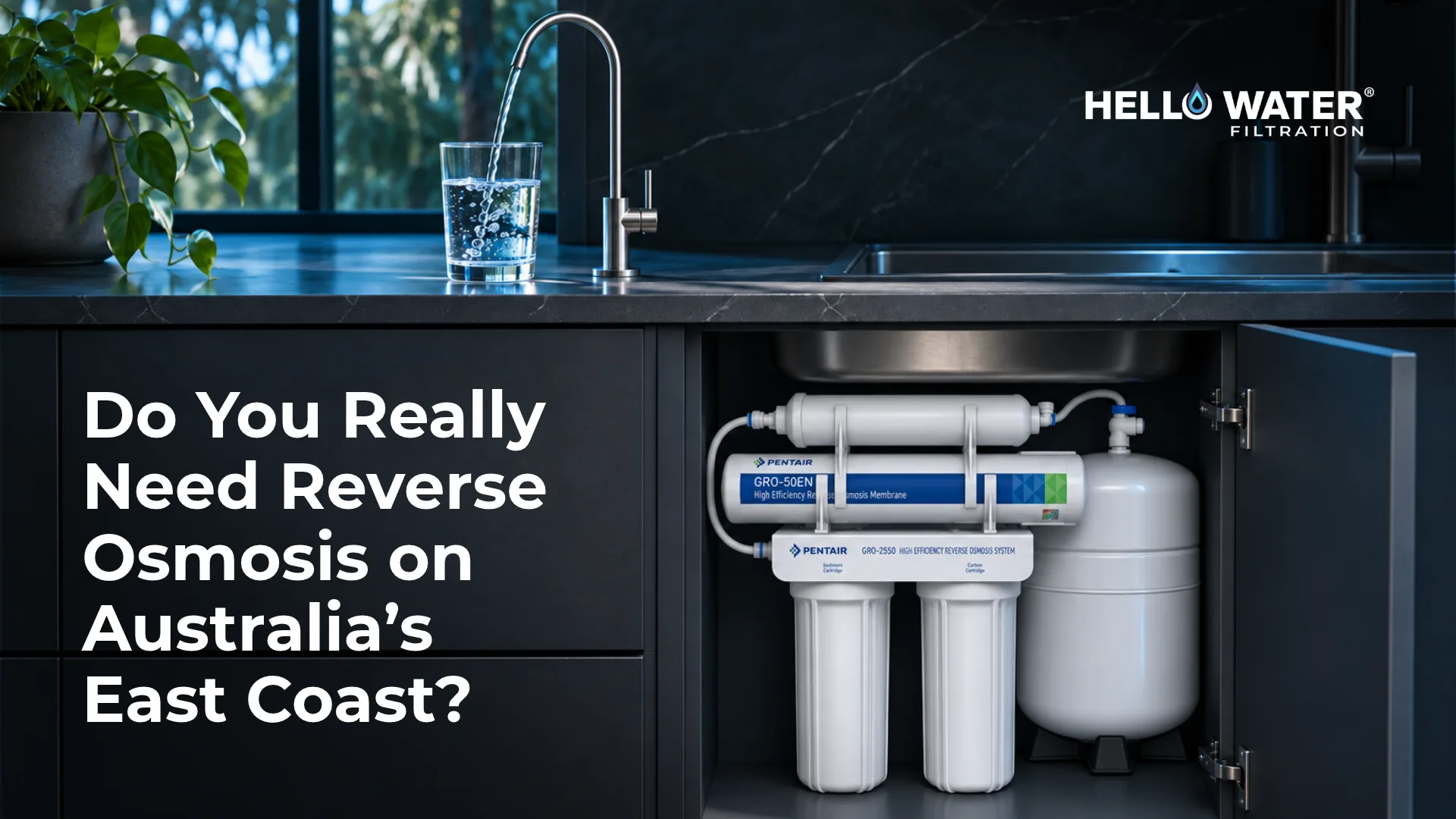
Reverse osmosis, commonly known as RO, is often described as one of the most advanced ways to filter drinking water. It can reduce a wide range of dissolved solids that standard water filters may be unable to remove.
But does every household on Australia’s east coast need a reverse osmosis system?
The right water filtration system depends on your water quality, what you want to remove & how you use your water. For some households, reverse osmosis can be useful. For others, a quality whole-home filtration system may be a more practical option.
So, what is reverse osmosis & how do you know which option is right for your home?
What Is Reverse Osmosis?
Reverse osmosis is a water treatment process that uses a semipermeable membrane to separate water from many dissolved substances.
Pressure pushes water through the membrane, leaving many contaminants behind. The filtered water is then ready for use.
Basic filtration systems can capture particles such as dirt, sand & rust. Cartridges designed to address taste, odour & colour can also reduce chlorine, depending on the filtration media. Reverse osmosis can target dissolved substances, including some forms of iron & other minerals. The combined concentration of these substances is commonly expressed as total dissolved solids (TDS).
Depending on the specific RO system & membrane, reverse osmosis can reduce certain salts, nitrates, fluoride, some metals & other dissolved substances.
Household RO systems are commonly installed at the point of use, such as a kitchen tap. Conventional whole-home filtration systems are installed at the point where water enters the home.
What Can Reverse Osmosis Remove?
One of the main reasons people consider RO is its ability to reduce dissolved contaminants.
Depending on the membrane & system design, reverse osmosis can reduce:
- Fluoride
- Nitrates
- Dissolved salts
- Certain metals
- Total dissolved solids (TDS)
- Some PFAS compounds
- Other dissolved substances
The effectiveness of an RO system depends on the specific membrane, water conditions & how well the system is maintained.
This is particularly relevant when it comes to PFAS. According to the National Health & Medical Research Council (NHMRC), treatment options such as reverse osmosis can reduce PFAS in drinking water. Effectiveness depends on the specific treatment system & how it operates.
When assessing a claim that a filter “removes PFAS”, look for independent performance testing that identifies the specific cartridge or membrane used & the PFAS compounds tested.
Does Australian Tap Water Need Reverse Osmosis?
Australia’s drinking water guidelines provide a framework for managing safe, good-quality drinking water. Drinking water regulators, health authorities & water suppliers across the country use the Australian Drinking Water Guidelines.
The NHMRC explains that its health-based guideline values are designed to protect human health & incorporate uncertainty factors.
Water quality can vary with the source, the local water supply & the plumbing within a property. It also depends on whether the home uses mains water, rainwater or water from a private bore.
In August 2026, ABC News reported elevated PFAS levels in untreated water from two West Wagga Wagga bores. Riverina Water said dilution had reduced PFAS levels in its treated water to within the Australian Drinking Water Guidelines. The example shows why both the water source & the treatment it receives matter when assessing household filtration needs.
For most households connected to a properly managed mains water supply, the decision to install reverse osmosis depends on what they want their filtration system to achieve.
- Do you want to improve taste & odour?
- Are you concerned about chlorine or chloramines?
- Do you want to reduce sediment?
- Are you looking to reduce dissolved contaminants such as fluoride, nitrates or certain PFAS?
These goals may require different filtration technologies.
What About PFAS?
PFAS have received increasing attention in Australia in recent years.
PFAS, or perfluoroalkyl & polyfluoroalkyl substances, are a large group of manufactured chemicals used in a wide range of industrial & consumer products.
In June 2025, after reviewing PFAS in drinking water, the NHMRC updated the Australian Drinking Water Guidelines. The update included health-based guideline values for several PFAS, including PFOS, PFOA, PFHxS & PFBS. These values are intended to provide a conservative level of protection.
Australian guidance indicates that PFAS concentrations are low in many drinking water supplies. If you are concerned about PFAS, check what has been found in your particular water supply.
Several treatment technologies can reduce PFAS, including granular activated carbon, ion exchange & reverse osmosis. ABC News has reported that reverse osmosis can be a household treatment option where additional PFAS reduction is required.
The same report notes that household RO systems require ongoing maintenance, including regular filter replacement. The need for additional treatment depends in part on the PFAS concentrations in the supplied water.
Reverse Osmosis vs Whole-Home Filtration
The main differences are where the water is treated & what each system is designed to target.
A reverse osmosis system is commonly installed at a specific point of use, such as under the kitchen sink. It can provide highly filtered water for drinking & cooking.
Whole-home filtration treats water as it enters your home, supplying filtered water to showers, bathrooms, the laundry & kitchen taps.
Depending on the filtration media used, whole-home systems can target sediment, chlorine, chloramines, taste, odour & other specific contaminants.
If your main concern is reducing dissolved substances that require membrane filtration, RO may be worth considering. If your priority is improving water quality throughout your home, a whole-home system may be more practical.
Is Reverse Osmosis Better Than a Whole-Home Filter?
The answer depends on which contaminants you want to reduce & where you want filtered water. RO typically provides highly filtered drinking water at a single outlet, while whole-home filtration treats the water entering your property so it can reach taps throughout the home.
There are practical differences, too. As ABC News explains, reverse osmosis separates treated water from a concentrated waste stream often called brine. RO systems also require regular maintenance, including filter & membrane replacement, to continue operating effectively.
When Might Reverse Osmosis Make Sense?
Reverse osmosis may be worth considering if your household needs to reduce specific dissolved contaminants that an RO membrane is designed to target. It can also be useful if you want highly filtered drinking water at a particular tap.
If your household uses bore water or another private supply, testing the water first can help you choose an appropriate treatment method based on what’s present.
When Might Whole-Home Filtration Make More Sense?
Whole-home filtration can be a practical option if you want better-tasting water, less sediment & lower levels of chlorine or chloramines throughout your home.
A properly designed system treats incoming mains water before it reaches the rest of the house. This gives your family access to filtered water for drinking, cooking, showering & everyday household use.
So, Do You Really Need Reverse Osmosis?
Reverse osmosis can be an effective water treatment technology. Whether it makes sense for your household depends on your water source, what’s in your water & what you want your filtration system to achieve.
If you’re concerned about a particular contaminant, find out whether it’s present in your water & whether the filtration system you’re considering has been independently tested to reduce it.
For everyday water quality throughout your home, a whole-home filtration system may be the more practical choice. If you need to reduce specific dissolved contaminants in your drinking water, reverse osmosis can provide additional treatment at the tap.
Looking for the Right Water Filtration System?
At Hello Water Filtration, we help you choose a filtration system based on your home’s water supply & your household’s needs.
Our whole-home filtration systems provide filtered water throughout your home. Depending on the system you choose, they can reduce sediment, chlorine & chloramines, as well as improve taste & odour.
If you’re unsure whether reverse osmosis or whole-home filtration is right for you, speak with the Hello Water team about your water supply & what you’d like to improve.